Projects / AI
Automated Student Attendance System with Age and Gender Prediction
AI-Powered Attendance Management System.
Overview
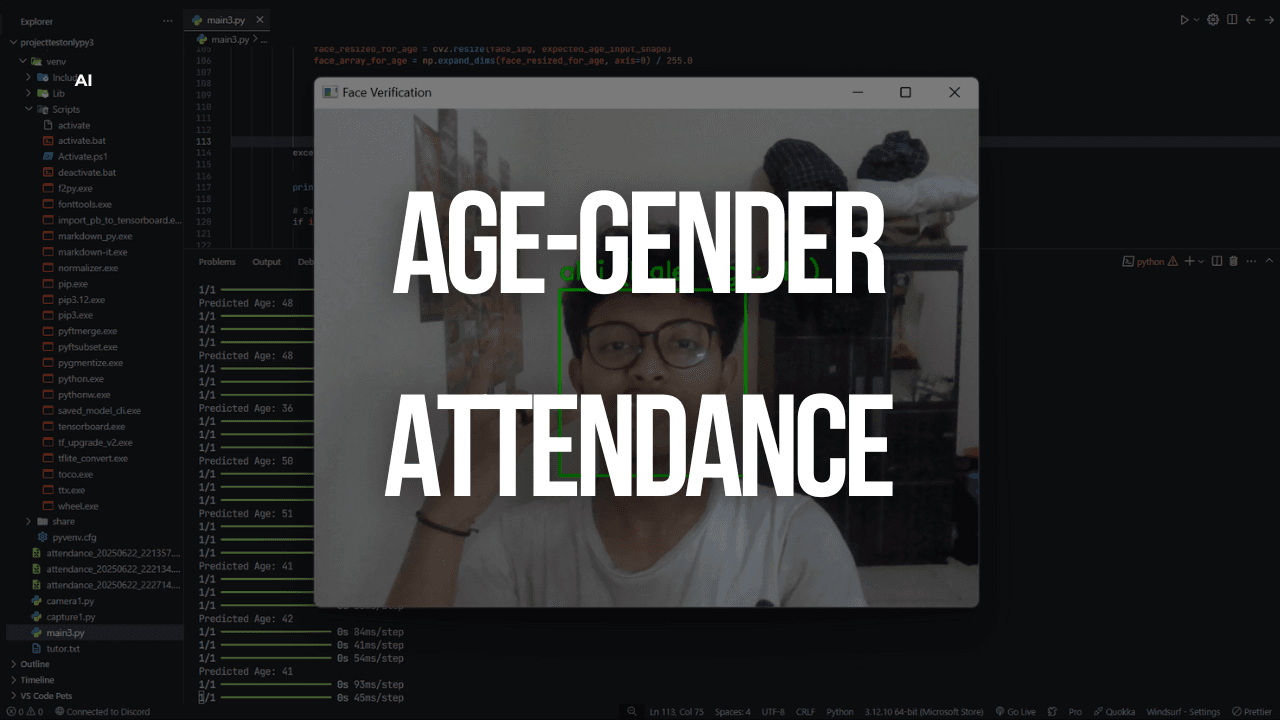
This project presents an AI-powered system designed to automatically record student attendance using facial recognition technology, while also predicting the user's age and gender. The system addresses the inefficiencies, inaccuracies, and security concerns found in traditional attendance methods.
Developed as part of a Computer Vision mini-project, the system demonstrates how deep learning and computer vision can be applied to real-world institutional needs.
1. Introduction
1.1 Background
In academic institutions, student attendance is a vital indicator of engagement and discipline. Traditionally, attendance is recorded through manual signatures, roll calls, QR code scanning, or fingerprint systems. While functional, these methods often prove inefficient, error-prone, and vulnerable to fraudulent behavior such as proxy attendance.
Moreover, physical-based systems like fingerprint scanners raise hygiene concerns and may not function reliably under certain conditions (e.g., wet or damaged fingers). QR codes also require optimal lighting and are susceptible to unauthorized sharing among students.
With advancements in artificial intelligence (AI) and computer vision, face recognition technology has emerged as a viable alternative. It offers a contactless, secure, and automated solution for attendance tracking. Beyond attendance, the integration of age and gender prediction adds value by enabling demographic analysis and access control based on user identity.
Despite its promise, implementing such systems poses challenges, particularly around environmental variables like lighting and facial obstructions, as well as ethical concerns such as privacy and data security. This project aims to design and implement a robust solution to address these issues effectively.
1.2 Problem Statement
Traditional attendance systems are inefficient, prone to errors, vulnerable to fraud, and lack adaptability. Manual roll calls consume valuable class time, while handwriting inconsistencies, technical failures, and human errors degrade data quality. Proxy attendance, facilitated by shared QR codes or manual sign-ins, undermines record accuracy. Fingerprint scanners, though advanced, are unreliable under varying physical or environmental conditions, such as wet or damaged fingers. To address these limitations, an AI-powered attendance system utilizing face recognition is proposed. This system enables contactless, real-time student identity verification, enhancing accuracy, efficiency, and security while minimizing manual intervention. Additionally, the system incorporates age and gender prediction, providing valuable demographic insights for educational institutions and enabling secure access control for restricted areas or facilities.
2. Tools & Technologies Used
| Tool | Purpose |
|---|---|
| OpenCV | Face detection and image preprocessing |
| MediaPipe | Facial landmark tracking |
| TensorFlow / Keras | Deep learning models for age and gender prediction |
| FaceNet | Face embedding generation for identity recognition |
| NumPy & PIL | Image manipulation and format conversion |
| Pandas | Structured data storage for attendance logs |
| Datetime | Timestamping attendance records |
3. ️ System Workflow & Results
Face Data Collection & Embedding Generation
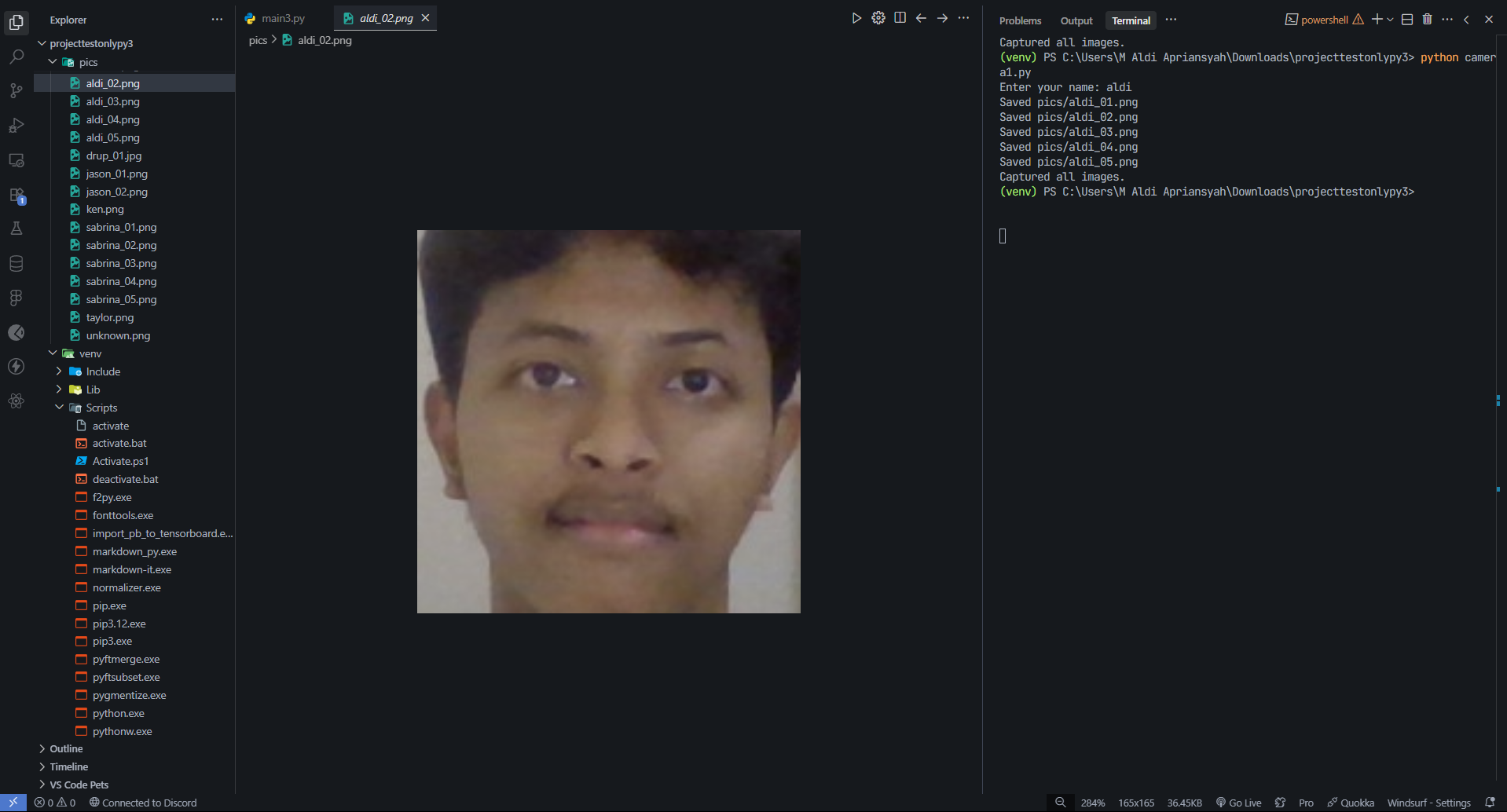
The system captures facial images of each user and stores multiple reference images for identity verification. The captured face images are then processed through an embedding generator to convert each face into a unique vector representation, which is stored in the system for future comparisons.
Real-Time Recognition & Attendance Logging
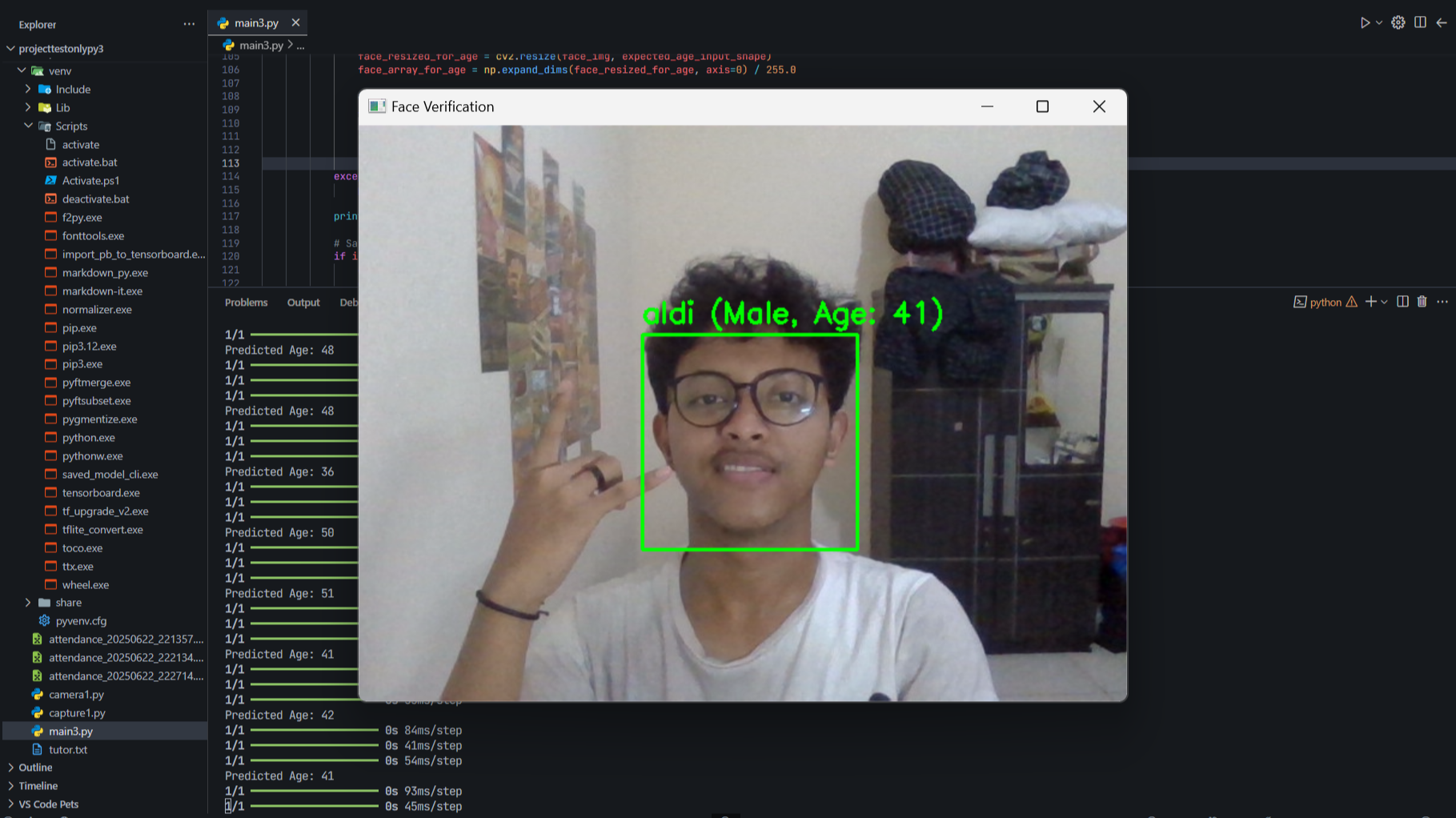
During system operation, the camera detects the user's face in real-time, predicts their age and gender, and verifies their identity based on stored face data. The system then logs attendance information including Full Name, Timestamp, and Predicted Age.
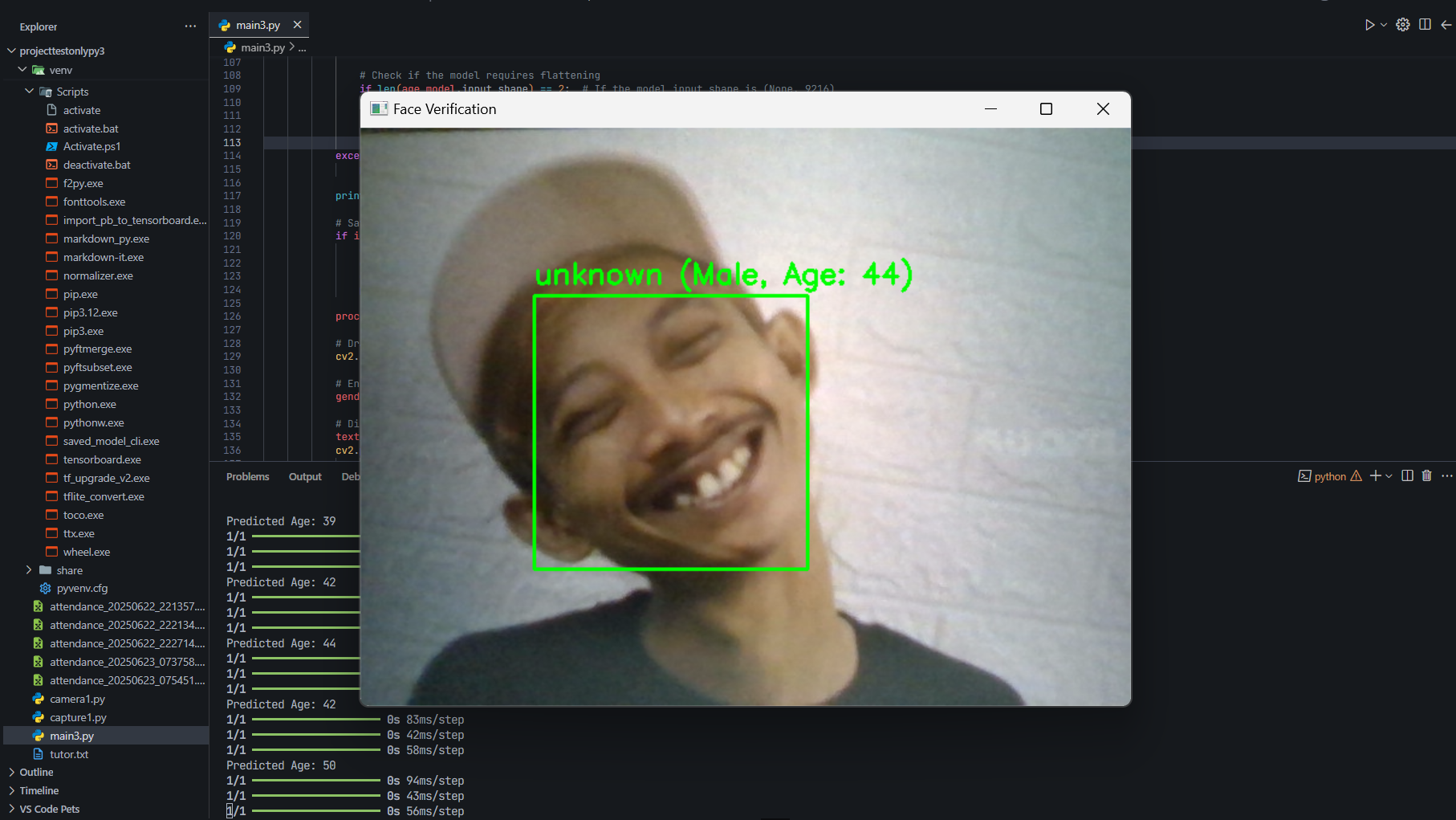
If the individual’s face is not recognized (not previously registered), the system still predicts age and gender, but logs the identity as “Unknown”.
️ Attendance Records
All verified entries are saved to a structured data log (e.g., Excel sheet), allowing administrators to review and analyze student attendance efficiently.

4. Model Evaluation & Optimization
The model evaluation process involved a series of experiments focused on adjusting the architecture, including the number of layers, layer sizes, and the addition of dropout layers. Several configurations were tested with varying epoch settings to optimize performance metrics such as accuracy, precision, and recall.
The table below presents key results from multiple iterations of model tuning, highlighting the gradual improvement in performance:
| Model Configuration | Training Accuracy | Validation Accuracy | Accuracy | Precision | Recall |
|---|---|---|---|---|---|
| before | 0.81 | 0.85 | 0.85 | 0.81 | 0.88 |
| first | 0.69 | 0.86 | 0.86 | 0.91 | 0.78 |
| change to 512 dense | 0.91 | 0.85 | 0.85 | 0.79 | 0.92 |
| 3,3 to 5,5 for first 2 layers | 0.91 | 0.87 | 0.87 | 0.84 | 0.89 |
| 512, 3,3, 20 epochs | 0.88 | 0.87 | 0.87 | 0.85 | 0.90 |
| ... 30 epochs | 0.91 | 0.90 | 0.90 | 0.89 | 0.90 |
Note: Accuracy/Loss plots and confusion matrix were not saved due to experimentation constraints. For future improvements, metric logging and visualization will be prioritized.
5. Limitations
While the system performs well under standard conditions, a few limitations are acknowledged:
- Lighting sensitivity: Detection accuracy may drop in low-light or overexposed environments.
- Age prediction variance: Age prediction may be off by several years due to visual ambiguity.
- Camera positioning: The system performs best when faces are clearly visible and centered.
- Unregistered users: Unrecognized individuals are labeled as "Unknown", regardless of actual identity.
These limitations reflect common challenges in real-world computer vision systems and highlight opportunities for further development.
6. Conclusion
This project demonstrates how AI and facial recognition can be effectively leveraged to automate student attendance in a secure, contactless, and efficient manner. By integrating age and gender prediction, the system not only enhances demographic insights but also opens up potential applications in identity verification and access control. Compared to conventional attendance methods, this solution reduces human error, prevents proxy attendance, and saves administrative time. Although certain practical challenges, still need refinement, the current implementation forms a solid foundation for future advancements and large-scale deployment.