Projects / Web Development, AI
CnC Hub
An AI-Powered Campus Community Platform.
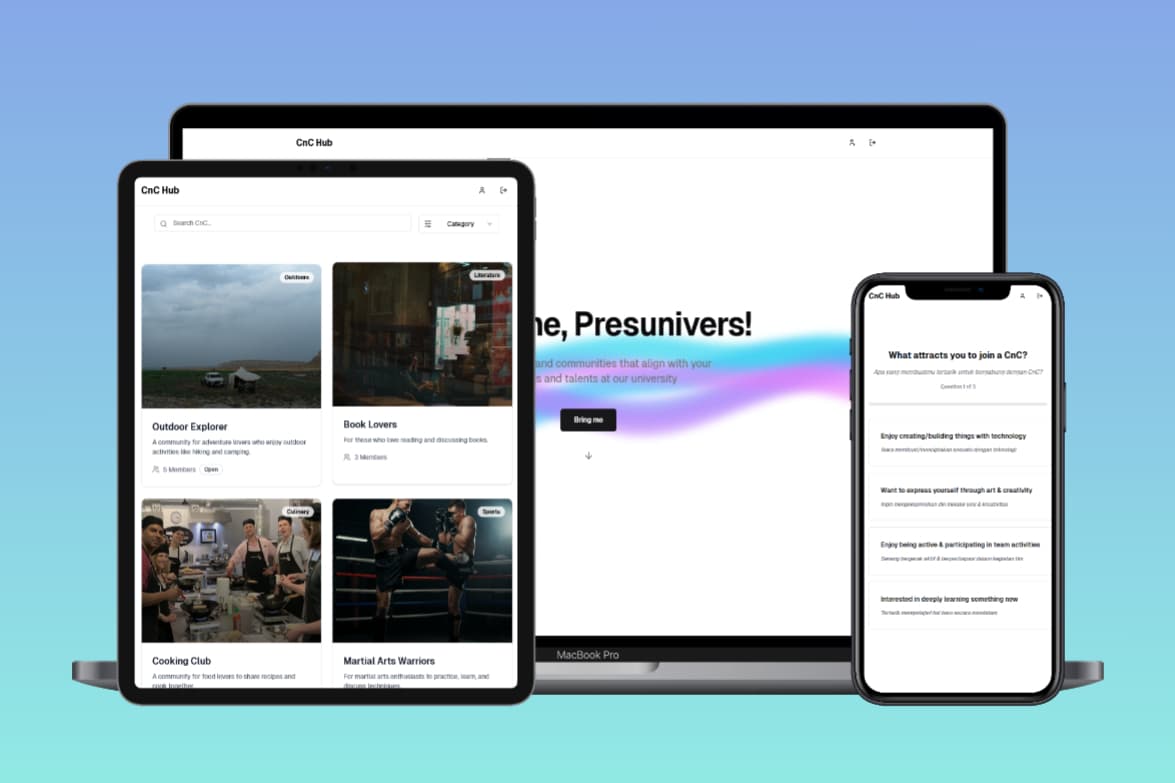
Overview
CnC Hub is a web application designed to bridge the gap between students and campus organizations at President University. The platform uses interest-based matching to help students discover communities aligned with their personal aspirations while providing organizations with digital tools to manage their activities and membership.
The Problem
University students often struggle to find communities that match their interests, resulting in low participation rates in campus activities. Community leaders face challenges in member recruitment, activity promotion, and administrative management. These issues create a disconnected campus environment where:
- Students remain unaware of communities matching their interests
- Organizations struggle with inconsistent recruitment methods
- Administrative processes are largely manual and inefficient
- Event promotion happens through fragmented channels
Solution Approach
Instead of developing another directory-style platform, CnC Hub was built as an intelligent matchmaking system with integrated management tools. The solution was developed using React, Firebase, and TensorFlow.js to create a sustainable platform that could evolve with campus needs.
Implementation Strategy
The development followed a user-centered approach with three primary phases:
-
Phase 1: Recommendation System Development
The core challenge was creating a recommendation algorithm that could accurately match students with relevant communities. This required implementing a text-based similarity system using TF-IDF and cosine similarity calculations that could process both explicit questionnaire data and community descriptions.
-
Phase 2: User Experience Design
The interface needed to serve both students seeking communities and organization leaders managing their groups. This dual audience required creating distinct but interconnected experiences within a single platform, including an accessible quiz system and administrative dashboard.
-
Phase 3: Community Management Tools
Organizations needed practical tools to manage membership applications, promote activities, and maintain their digital presence. The implementation included role-based access controls and streamlined approval workflows.
Technical Architecture
The application architecture was designed for scalability while maintaining performance:
Frontend
- Framework: React 18 with Vite for optimized build performance
- UI Components: ShadCN UI with TailwindCSS for responsive design
- State Management: React Context API for efficient global state handling
- Animation: Framer Motion for smooth transitions and micro-interactions
Backend Services
- Authentication: Firebase Authentication with email and OAuth providers
- Database: Firestore NoSQL database with optimized document structure
- Storage: Firebase Storage for community media assets
- Hosting: Firebase Hosting with CDN for global delivery
Recommendation Engine
- Core Algorithm: TF-IDF implementation for text similarity analysis
- Processing: TensorFlow.js for client-side vector computations
- Scoring System: Multi-factor analysis including content relevance, category alignment, and activity metrics
- Performance: Optimized vocabulary generation and vector calculations for sub-100ms response times
Results and Impact
The platform successfully addressed the initial problems with measurable outcomes:
Student Perspective: Students now discover communities that align with their interests through personalized recommendations, resulting in increased participation in campus activities and a more connected university experience.
Organization Perspective: Community leaders gained efficient digital tools for member management, communication, and event promotion, reducing administrative overhead and improving recruitment effectiveness.
University Perspective: The platform provided valuable insights into student interests and engagement patterns, helping inform broader campus initiatives and resource allocation.
This project demonstrates my ability to identify real-world problems and develop comprehensive technical solutions that create measurable impact for multiple stakeholders.